
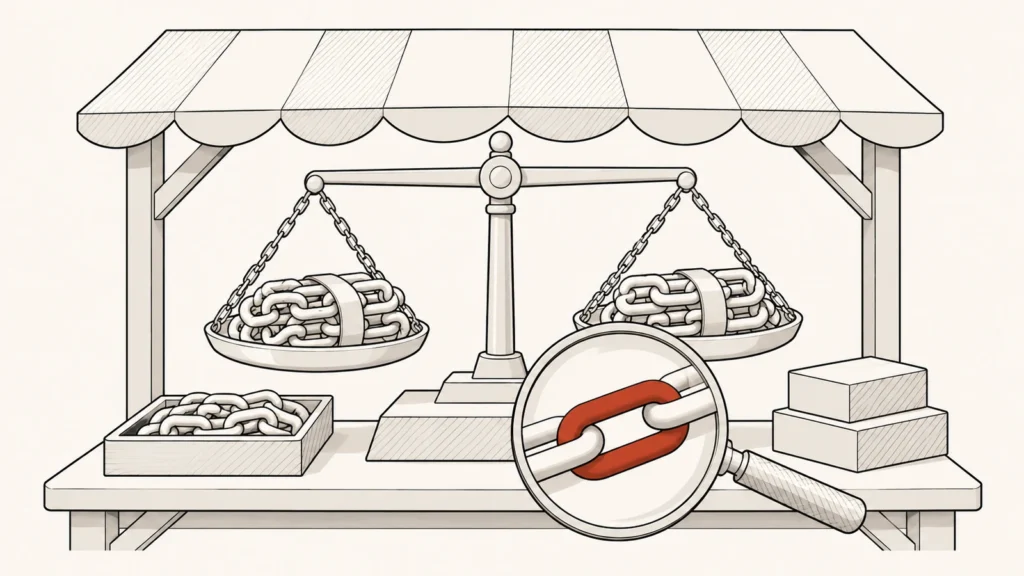
Google’s spam policies prohibit buying links that pass ranking credit. Paid links are allowed only when marked rel=”sponsored” or rel=”nofollow”. In practice, many paid links are simply ignored by Google’s systems, some still work for a time, and patterns of buying at scale can lead to manual actions. The risk grows with volume and visibility.
What the rules say
Google’s link scheme policy is one of the clearest parts of its spam guidelines. Buying or selling links that pass ranking credit is prohibited, whether the payment is money, goods, services or a free product in exchange for a link. The policy also covers excessive link exchanges, large-scale article campaigns with keyword-rich links, and links required as part of a terms of service or contract.
Paying for a link is not itself the problem. Sponsorships, advertising and paid placements are normal business. The rule is that those links must be marked so they do not pass ranking credit, using rel=”sponsored” or rel=”nofollow”. A paid link with the right attribute is fine. A paid link presented as an editorial endorsement is what the policy targets.
What actually happens to paid links
Practitioners know that paid links are everywhere, and many sites that buy them rank well. That apparent contradiction comes from how Google enforces the policy.
Many paid links are ignored. Google’s systems are designed to recognize and discount links that look manipulative, particularly from sites that sell links openly or appear in known networks. When that happens, the link does nothing. There is no penalty; the money is simply wasted. This is the most common outcome and the hardest to see, because nothing visibly breaks.
Some paid links work, for a while. Links placed in genuine articles on real, relevant sites can be very hard to distinguish from editorial links. These are the ones that sometimes move rankings, which keeps the market alive.
Patterns get caught. Buying at scale leaves patterns: many links from sites with similar profiles, exact-match anchors, sudden spikes, links on pages that openly advertise “sponsored posts” without the right attributes. Patterns are what algorithms detect and what manual reviewers act on. A manual action for unnatural links can remove a site’s rankings until the links are cleaned up and a reconsideration request is accepted.
Sellers get hit too. Sites that sell links that pass ranking credit risk having their outbound links ignored or receiving manual actions themselves, which in turn makes every link they sold worthless.
Why the market persists
Link selling persists because the costs are delayed and the outcomes are hard to attribute. A buyer who sees rankings rise after buying links rarely knows whether the links caused it. A buyer whose links are ignored rarely finds out. Sellers advertise authority scores that are easy to inflate and say nothing about whether Google counts the links.
That opacity cuts both ways. It is why some people succeed with paid links, and why many more spend money for nothing. The more a seller emphasizes metrics like DR, guaranteed placements and quick turnarounds, the more likely the site is part of a network Google already discounts.
Paid options that stay within the rules
If you have budget for links, there are ways to spend it that do not depend on Google missing anything.
Sponsorships and partnerships with organizations in your field, with links marked sponsored. They bring visibility and relationships even without ranking credit.
Digital PR, where the money goes into creating something newsworthy, such as original data, research or a tool, and promoting it to journalists and writers who may cite it editorially.
Content and tools worth linking to, where the investment is in the asset rather than the placement.
Advertising in publications your audience reads, valued for traffic and brand rather than links.
These are slower and less predictable than buying a list of placements, but the links they produce are the kind Google is trying to reward.
If you have already bought links
Many sites have paid links in their history. The practical approach is to look at what you have bought, focusing on links that sit on obvious link-selling sites, use exact-match anchors, or came in a sudden batch. If Search Console shows a manual action for unnatural links, those links need to be removed or neutralized before a reconsideration request will succeed. If there is no manual action, Google’s systems may already be ignoring the worst of them, and the more useful work is building better links going forward.
Paid links are the clearest case in white hat vs black hat SEO. The usual ways people disguise them are paid guest posts and private blog networks.
Frequently asked questions
Will Google penalize me for buying one or two links? Unlikely. Small numbers of paid links are more likely to be ignored than to trigger action. The risk rises with volume, obvious patterns and links from sites that openly sell placements.
Is paying for a guest post the same as buying a link? If the payment is for a link that passes ranking credit, yes. Paying a publication to run your article is fine if the links are marked sponsored or nofollow. Paying specifically to place followed links is what Google’s link policy describes.
How can Google tell a link was paid for? Often it cannot from a single link, which is why individual paid links sometimes work. It is much better at recognizing sites that sell links and patterns across many links, and it also receives spam reports.
Are niche edits safer than new guest posts? Not as such. Paying to insert a followed link into an existing article is still buying a link. It can be harder to detect, but it sits under the same policy.
Sources
- Google Search Central, Spam policies for Google web search (link spam)
- Google Search Central, Qualify your outbound links to Google
